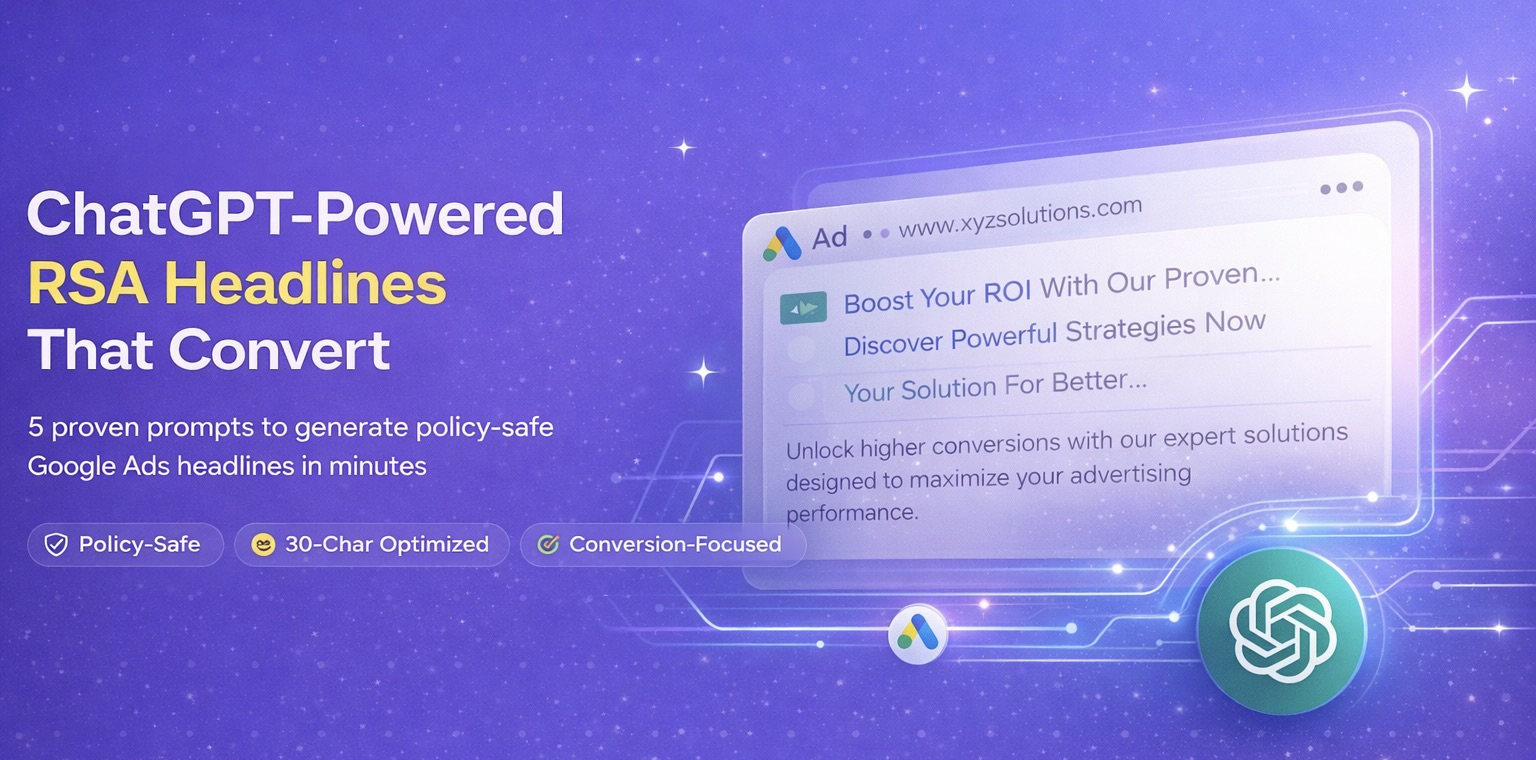
Introduction: The RSA Headline Struggle Is Real
If you've ever stared at that blank Google Ads interface, cursor blinking mockingly at you while you try to conjure 15 unique, compelling headlines for a Responsive Search Ad, you know the pain.
The requirement isn't arbitrary—Google's machine learning needs variety to test combinations and find winners. But writer's block doesn't care about algorithmic optimization. By headline number eight, you're recycling the same value propositions with slightly different word orders. By headline twelve, you're contemplating career changes.
Enter ChatGPT for Google Ads.
This isn't about replacing your strategic judgment with artificial intelligence. You still need to understand your audience, your offer, and your competitive positioning. What ChatGPT provides is a brainstorming partner that never runs out of variations—if you give it the right instructions.
Generic prompts produce generic headlines. But strategic prompts, fed with the right context about your user persona and unique selling proposition, can generate high-CTR headlines that your human brain might never have considered. The difference between mediocre AI output and brilliant copy is entirely in how you prompt the system.
This guide will show you exactly how to do it.
The "Garbage In, Garbage Out" Rule: Why Context Matters
Before we dive into specific prompts, understand this fundamental principle: ChatGPT doesn't know your business, your customers, or your competitive advantage unless you tell it.
A prompt like "Write 15 Google Ads headlines for running shoes" will give you generic, forgettable output like:
- "Buy Running Shoes Today"
- "Quality Running Footwear"
- "Shop Running Shoes Now"
These headlines aren't wrong—they're just completely interchangeable with every other running shoe advertiser. They fail the substitution test: if you could swap your brand name for a competitor's and the headline still works perfectly, it's not strategic.
High-converting headlines require two critical inputs:
-
User Persona Context: Who is searching? What problem are they trying to solve? What language do they use? A marathon runner searching for "minimalist trail shoes" has completely different needs than a casual jogger looking for "comfortable sneakers for walking."
-
Unique Selling Proposition (USP): What makes your offer different? Free shipping isn't a USP when everyone offers it. A proprietary cushioning technology, a 365-day trial period, or carbon-negative manufacturing—these are differentiators worth highlighting.
When you feed ChatGPT this strategic context, the Google Ads headline generator becomes significantly more valuable. The AI can mirror your customer's language, emphasize your actual competitive advantages, and create variations that maintain strategic coherence while offering the diversity RSAs need.
Now let's get to the specific prompts that make this happen.
The Core Value: 5 Copy-Pasteable Prompt Templates for RSA Headlines
Prompt 1: The "Pain-Agitation-Solution" Framework
This prompt forces ChatGPT to start with the user's problem, not your product features.
Copy-Paste Prompt:
You are writing Google Ads headlines (max 30 characters each) for Responsive Search Ads.

Target audience: [specific persona, e.g., "small business owners struggling with payroll complexity"]
Main pain point: [specific problem, e.g., "spending 8+ hours per month on manual payroll calculations"]
Our solution: [how you solve it, e.g., "automated payroll software that syncs with accounting tools"]

Generate 15 headlines that:
1. Acknowledge the pain point in the user's own language
2. Imply the transformation or relief we provide
3. Stay under 30 characters
4. Avoid generic claims like "best" or "leading"

Focus on emotional resonance, not feature lists.
Why this works: Pain-agitation-solution is one of the most effective AI copywriting prompts because it forces emotional connection before product mention. Users click on ads that understand their frustration, not ads that list features.
Example output you might get:
- "Payroll Done in 5 Minutes"
- "No More Payroll Headaches"
- "Automate Away Payroll Stress"
Prompt 2: The "Competitor Pivot"
When users are comparison shopping, you need to highlight advantages without triggering Google's trademark policies.
Copy-Paste Prompt:
You are writing Google Ads headlines (max 30 characters) for Responsive Search Ads.

Our product: [your service/product]
Competitors typically offer: [common competitor features, e.g., "basic CRM with limited integrations"]
Our differentiator: [what you do better, e.g., "native integration with 500+ tools, no Zapier needed"]

Generate 15 headlines that:
1. Highlight what we offer that competitors don't
2. Use comparison language WITHOUT naming competitors (e.g., "unlike basic CRMs...")
3. Focus on the outcome of our advantage, not just the feature
4. Stay under 30 characters

Avoid superlatives like "best" unless backed by verifiable claims.
Why this works: This prompt teaches ChatGPT to write Responsive Search Ads optimization copy that positions you against the competitive set without violating ad policies. Google prohibits naming competitors in most cases, but comparative language ("more integrations," "faster setup," "no hidden fees") is perfectly acceptable.
Example output you might get:
- "500+ Integrations Included"
- "No Zapier Required Here"
- "Beyond Basic CRM Limits"
Prompt 3: The "Keyword Injection" Prompt
Quality Score depends partly on ad relevance, which means your target keyword should appear naturally in some headlines.
Copy-Paste Prompt:
You are writing Google Ads headlines (max 30 characters) for Responsive Search Ads.

Primary keyword to include: [exact keyword, e.g., "ERP software for manufacturing"]
Target audience: [who's searching]
What they care about: [main benefit or outcome]

Generate 15 headlines where:
1. At least 5 headlines include the exact keyword phrase naturally
2. The keyword feels contextual, not stuffed
3. Each headline emphasizes a different benefit or angle
4. All headlines stay under 30 characters

Prioritize readability over keyword density.
Why this works: Google's algorithm rewards relevance. When your headline matches the search query, your Quality Score improves, which lowers your CPC and improves ad position. This prompt ensures ChatGPT for Google Ads generates keyword-rich headlines that don't sound robotic.
Example output you might get:
- "ERP Software Built for Mfg"
- "Manufacturing ERP You'll Use"
- "Streamline with Mfg ERP"
Prompt 4: The "Emotional Trigger" Prompt
Sometimes rational benefits aren't enough. You need urgency, exclusivity, or FOMO (fear of missing out).
Copy-Paste Prompt:
You are writing Google Ads headlines (max 30 characters) for Responsive Search Ads.

Product/Service: [what you offer]
Promotion or urgency factor: [e.g., "limited-time 40% discount," "only 50 spots available," "last day to enroll"]

Generate 15 headlines that:
1. Create urgency or exclusivity without sounding spammy
2. Use power words like "limited," "exclusive," "today only," "ending soon"
3. Balance emotional trigger with credibility
4. Stay under 30 characters

Avoid ALL CAPS or excessive punctuation.
Why this works: Emotional triggers increase click-through rates when used strategically. This prompt helps you generate high CTR headlines that leverage scarcity or exclusivity without crossing into clickbait territory.
Example output you might get:
- "40% Off Ends Tonight"
- "Last 50 Spots Available"
- "Exclusive Early Access Now"
Prompt 5: The "Character Count Constraint" Prompt
The biggest mistake when using AI for ad copy? Forgetting that Google Ads headlines have a hard 30-character limit.
Copy-Paste Prompt:
You are writing Google Ads headlines for Responsive Search Ads. The character limit is STRICTLY 30 characters including spaces.

Product/Service: [what you offer]
Main benefits: [list 3-5 key benefits]

Generate 15 headlines that:
1. Are ALL under 30 characters (count carefully)
2. Use abbreviations where appropriate (e.g., "Mfg" for Manufacturing, "&" instead of "and")
3. Prioritize punchy, action-oriented language
4. Include a mix of benefit-focused and feature-focused headlines

After generating each headline, verify character count and adjust if needed.
Why this works: ChatGPT sometimes generates headlines that exceed character limits, especially if you don't explicitly instruct otherwise. This prompt makes character count the primary constraint, forcing the AI to be concise and creative with word choice.
Example output you might get:
- "Try Free for 30 Days" (20 chars)
- "No Setup Fees Ever" (18 chars)
- "Live Support 24/7/365" (21 chars)
Refining the Output: Apply Human Logic
ChatGPT is a starting point, not a finished product. You still need human review for three critical reasons:
Check Google Ads Policy Compliance
AI doesn't know Google's current advertising policies. Manually verify that your AI-generated headlines avoid:
- Excessive capitalization: "BEST DEAL EVER" will get disapproved
- Prohibited claims: "Cure diabetes" or "guaranteed weight loss" violate health claims policies
- Trademark violations: Even if ChatGPT doesn't name competitors, verify you're not inadvertently using protected terms
- Misleading urgency: "Offer ends today" requires actual proof of a time-limited promotion
Ensure Strategic Variety Across Headlines
Google's RSA algorithm tests different combinations. You want variety in:
- Tone: Mix rational (features/benefits) with emotional (transformation/relief)
- Length: Use short punchy headlines (15-20 chars) and longer ones (28-30 chars)
- Focus: Some headlines should emphasize the problem, others the solution, others the differentiator
If all 15 headlines say essentially the same thing in different words, you're not giving Google's algorithm enough to work with.
Test for the Substitution Rule
Read each headline and ask: "Could my competitor use this exact headline?" If yes, it's too generic. Revise to incorporate your actual USP, specific pricing advantage, or proprietary methodology.
A headline like "Affordable Marketing Tools" could apply to anyone. A headline like "Marketing Tools Under $50/mo" is specific and differentiating.
FAQ: Common Questions About Using AI for Google Ads Copy
Does Google Penalize AI-Generated Content in Ads?
No. Google evaluates ads based on relevance, policy compliance, and user experience—not authorship. Whether a human or AI wrote your headline is irrelevant. What matters is whether the headline is truthful, compliant, and valuable to searchers.
That said, AI-generated copy still requires human oversight to ensure accuracy and policy compliance. Google penalizes misleading claims or policy violations regardless of who wrote them.
Can I Bulk Generate Headlines for Multiple Campaigns?
Yes, but use a structured approach. Create a spreadsheet with:
- Campaign name
- Target keyword
- User persona
- USP
- Specific pain points
Then run each row through your chosen prompt template. This systematic approach ensures consistency while maintaining campaign-specific relevance. Many agencies use this method to scale AI copywriting prompts across dozens of client accounts.
How Often Should I Refresh RSA Headlines Using ChatGPT?
Google recommends reviewing ad performance every 30-60 days. Use ChatGPT to generate fresh variations when:
- Click-through rate plateaus or declines
- You launch new features or promotions
- Competitor messaging shifts in the SERP
- Seasonal factors change user intent
Don't change high-performing headlines just for the sake of change—but do use AI to test new angles against your current control headlines.
Conclusion: Test These Prompts Today
The difference between struggling to write 15 RSA headlines and generating dozens of strategic options in minutes is entirely about how you prompt ChatGPT for Google Ads.
Generic inputs produce generic headlines. Strategic prompts that incorporate user personas, pain points, USPs, and specific constraints produce headlines worth testing.
Start with Prompt 1 (Pain-Agitation-Solution) for your next campaign. Feed ChatGPT real information about your customer's problems and your unique solution. Review the output for policy compliance and strategic variety. Then let Google's algorithm test combinations and surface winners.
The goal isn't to replace your marketing judgment—it's to augment your creative capacity. Use AI to break through writer's block, explore angles you hadn't considered, and generate the volume of variations that Responsive Search Ads optimization requires.
Your next high-converting headline is one prompt away.