
It is the question keeping every marketing manager awake at night:
"If Google's AI answers the user's question directly on the results page, why would anyone click my link?"
For the last 20 years, the deal was simple: You write helpful content, Google sends you traffic. In 2026, that deal has changed.
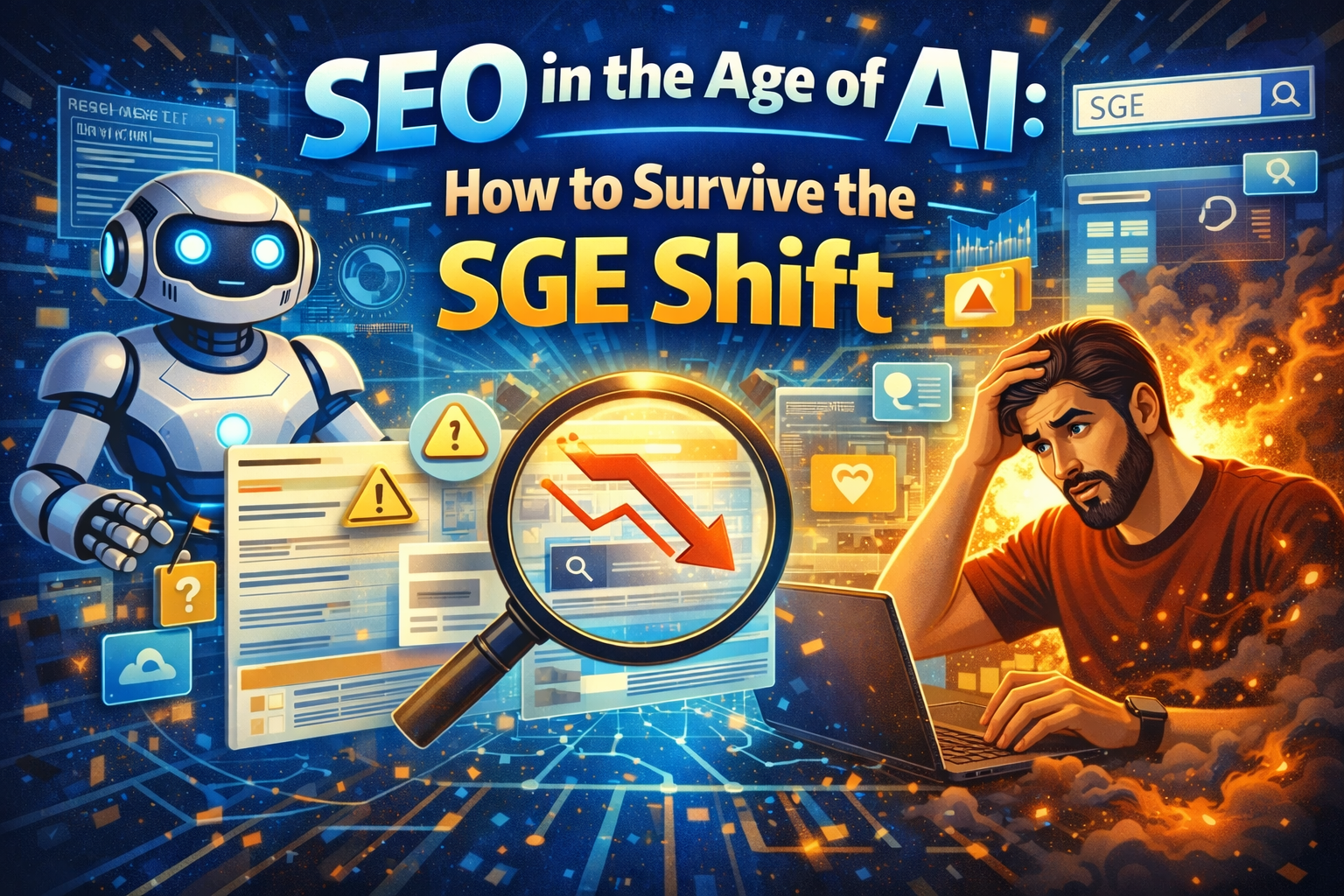
With the rollout of Google's Search Generative Experience (SGE) and "AI Overviews," Google has evolved from a Search Engine (a librarian pointing to books) to an Answer Engine (a consultant giving you the summary).
Is SEO dead? No. Is "Old School" SEO dead? Absolutely.
If you are still stuffing keywords into 500-word blog posts, you are invisible. Here is the reality of the new landscape and the survival guide you need.
The "Zero-Click" Reality
The hardest truth to accept is this: Top-of-Funnel (ToFu) traffic is evaporating.
If a user searches "What is the best time to post on Instagram?", the AI Overview gives them the answer instantly. They don't need to click your blog. They get the info and leave.
The Prediction: We are seeing a 20-40% drop in organic traffic for broad, informational queries.
The Opportunity: While volume is down, quality is up. The users who do click are no longer looking for a definition; they are looking for deep expertise, data, or a specific solution. The "tire kickers" are gone.
The New Strategy: Optimize for "Information Gain"
In the age of SGE, you cannot rank by rewriting what is already on Page 1. The AI can summarize Page 1 better than you can.
To rank now, you need Information Gain. You must provide something the AI cannot find elsewhere.
1. Own the "E" in E-E-A-T
Google added an extra "E" to E-A-T (Expertise, Authoritativeness, Trustworthiness). It stands for Experience.
-
AI: Can explain how to change a tire.
-
You: Can explain what went wrong when you changed a tire in the rain last Tuesday.
Action Item: Audit your blog. If a post could be written by someone who has never done the thing they are writing about, delete it or rewrite it. Add personal anecdotes, photos you took yourself, and "In my opinion" statements.
2. Become the Source of Data
AI is a summarizer, not a researcher. It cannot run a survey. It cannot test software.
-
The Strategy: Instead of writing "7 Best Email Tools," run a test where you actually subscribe to all 7 and time how long it takes to send a campaign.
-
The Result: The AI will cite YOU as the source of the data in its answer.
3. Target "Hidden Gem" Queries
Google's "Perspectives" filter and "Hidden Gems" algorithm update are designed to surface human voices (Reddit threads, forum discussions, personal blogs).
-
The Strategy: Target subjective keywords.
-
Bad Keyword: "Best CRM software" (AI answers this).
-
Good Keyword: "HubSpot vs. Salesforce for small agency reddit" (AI struggles with nuance).
-
The Survival Checklist for 2026
If you want to maintain your traffic this year, run this audit on your website immediately:
-
Kill the "What Is" Content: Stop defining terms. Assume the user knows the basics or let the AI handle it. Start your content at the "Advanced" level.
-
Add Author Bios Everywhere: Make sure every post is linked to a real human with a LinkedIn profile. Anonymous content is treated as spam.
-
Diversify Traffic: If you are 100% dependent on Google, you are vulnerable. Start that newsletter. Build that community. Own your audience.
The Bottom Line
SGE isn't the end of SEO; it's the end of mediocre SEO.
The internet is drowning in generic, AI-generated noise. This is your advantage. The more "synthetic" the web becomes, the more valuable your authentic, human experience becomes.
Don't try to out-robot the robot. Be the human expert it has to quote.